The observing programme
Between July 2025 and June 2026 I recorded 29 exoplanet transits of 23 planets with R60, my 0.305 m (12") Ritchey-Chretien in Nerpio, Spain (IAU Minor Planet Center code R60; ZWO ASI 2600 Mono camera, R band). Every measurement was submitted to the ExoClock project, which maintains transit ephemerides for the candidate targets of ESA's Ariel mission, and each was independently re-reduced and quality-controlled there. How I built R60.
The observations

Table 1 lists every transit with its measured mid-transit residual (O - C), host-star magnitude, transit depth, transit duration, and planet-to-star radius ratio. The four sections below take those columns in turn, because each one stresses the observatory in a different way.
Transit timing: precision and accuracy
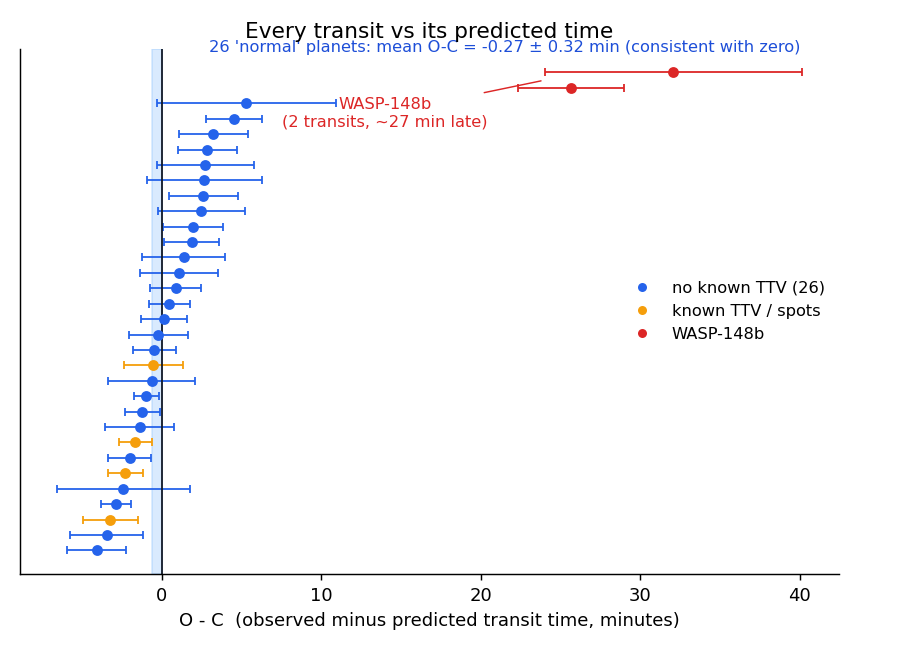
Every transit yields a mid-transit time, which I compare to the published constant-period ephemeris to get the residual O - C. Two distinct numbers describe how good that is.
Precision - the per-transit uncertainty - has a median of 1.9 minutes, from a best of 0.79 minutes (WASP-59b) to 4.2 minutes on the faint TOI-3819b; 17 of 29 transits are timed to better than two minutes. Accuracy - any systematic offset - is the more important test. Taking the 24 targets with no known timing anomaly, the error-weighted mean residual is O - C = -0.28 ± 0.32 minutes, consistent with zero to about 20 seconds. There is no detectable clock or reduction bias, and the scatter matches the quoted uncertainties (reduced chi-square near 1.6). A flat, zero-centred baseline is what makes a genuine anomaly believable when one appears.
Transit durations
Durations span 1.4 hours (TrES-3b) to 5.8 hours (KELT-12b), with a median near 2.3 hours. Duration sets the observing burden directly: a usable lightcurve needs the transit itself plus roughly an hour of stable baseline on each side, so KELT-12b's 5.8-hour event requires an uninterrupted run approaching eight hours, and that out-of-transit baseline is what constrains the depth and the mid-time. The shortest events (TrES-3b and TOI-2109b, both under 1.9 hours) are easier to bracket in a single night but contain fewer in-transit points, so their timing precision rests on high cadence rather than on a long baseline.
Host-star brightness
The host stars run from V = 10.2 (TOI-2109b, XO-6b) to V = 14.3 (Kepler-17b) - a factor of roughly 25 in apparent brightness. My timing precision shows essentially no dependence on magnitude (correlation -0.03): Kepler-17b, at V = 14.3 in the original Kepler field, was timed to 2.2 minutes, no worse than targets three magnitudes brighter. For a 0.3 m telescope this is the point of building for millimagnitude photometry - on these targets the limiting factor is the transit signal itself, not photon noise from the star.
Transit depths
Depths range from 0.60% (HAT-P-7b, KELT-12b) to 2.74% (TrES-3b), a factor of about 4.5. Unlike magnitude, depth does drive precision, exactly as expected: the correlation is -0.49, because a deeper transit gives the model more signal to fix the mid-time onto. Detecting a 0.60% dip - six parts in a thousand - and still timing it to about two minutes is the demanding end of this range, and R60 reaches it on HAT-P-7b, KELT-12b, and the ultra-hot TOI-2109b.
What the sample contains

The 23 planets are a hot-Jupiter zoo: from the 3,600 K, 16-hour TOI-2109b to the cool 670 K, 7.9-day WASP-59b; masses of 0.29 to 6.1 Jupiter masses; several hugely inflated, such as XO-6b at roughly twice Jupiter's radius. By discovery survey, 5 are TESS objects (TOI-2046b, 2109b, 2154b, 3819b, 4463A b), 1 is from Kepler (Kepler-17b), and 17 come from ground-based surveys (HATNet, WASP, KELT, TrES, XO, Qatar). Two sit in multi-planet systems: WASP-148 (planets b and c) and HAT-P-17 (a hot Jupiter with a distant giant companion).
The transit-timing detection
The reason to time these transits is to find systems whose period is not constant. WASP-148b is the clear case: it transits about 26 minutes later than a constant-period prediction, consistently across three of my measurements (Table 1 shows two, at +32 and +26 minutes), pulled by the outer planet WASP-148c. Against the 24-planet zero baseline, that offset is a real transit-timing variation, not an instrumental artefact. Full WASP-148b analysis. Three further targets are ExoClock-flagged for timing variations - WASP-135b, TrES-3b, and HAT-P-7b - and warrant continued monitoring.
Orbital-decay candidates
The two shortest-period planets, TOI-2109b (16-hour orbit) and KELT-16b (23-hour orbit), are prime candidates for slow tidal orbital decay, a measurable shrinking of the period over years. Confirming decay needs a long, dense timing baseline, which is precisely what repeated ExoClock measurements build.
Feeding ESA Ariel
Every planet here is an Ariel candidate target. Ariel launches around 2029 to characterise the atmospheres of roughly a thousand exoplanets, and it can only schedule a transit it can predict; ephemerides drift over the years unless they are refreshed. Each mid-transit time I contribute narrows that prediction. Across 29 transits, this is a small but concrete contribution to keeping the Ariel target list observation-ready.
The 29 transits
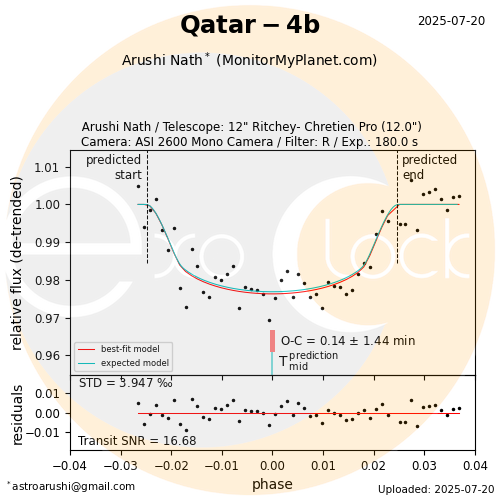
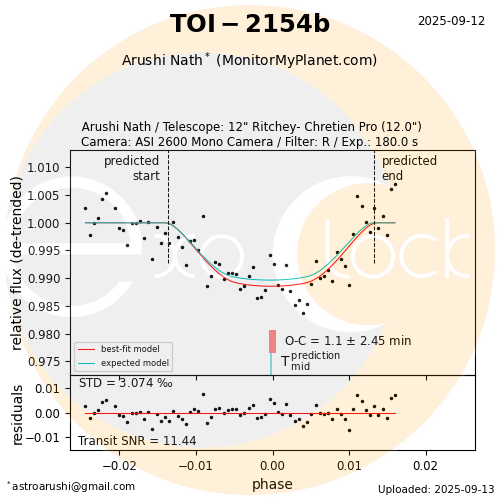
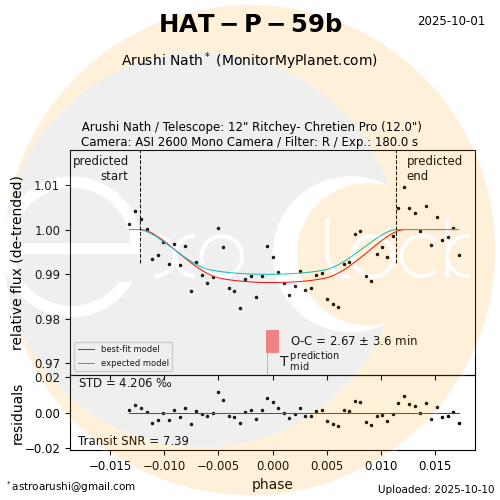
Every transit below was reduced and quality-controlled by ExoClock. Each card shows the folded lightcurve, the fit, and the measured mid-transit time.
WASP-148b · 2025-07-15 - A sub-Saturn in a two-planet TTV system; transits arrive tens of minutes late from the pull of WASP-148c.

WASP-2b · 2025-07-19 - Compact hot Jupiter.

Qatar-4b · 2025-07-20 - Super-massive hot Jupiter (6.1 Jupiter masses) on a faint star; a deep 1.9% transit.
HAT-P-7b · 2025-07-21 - Ultra-hot Jupiter (~2,700 K), flagged by ExoClock for transit-timing variations.

KELT-12b · 2025-07-21 - Hugely inflated hot Jupiter (1.8 Jupiter radii); a shallow ~0.6% transit.

TOI-2109b · 2025-07-22 - An extreme ultra-hot Jupiter: a 16-hour orbit near 3,600 K, and a tidal-decay candidate.

WASP-2b · 2025-07-22 - Compact hot Jupiter.

TOI-4463Ab · 2025-08-02 - TESS-discovered hot Jupiter orbiting one star of a binary.

TrES-3b · 2025-08-03 - Short-period hot Jupiter flagged for TTV; the deepest transit in my set (2.7%).

HAT-P-23b · 2025-08-04 - Compact hot Jupiter on a 1.2-day orbit.

WASP-59b · 2025-08-04 - A cooler, longer-period hot Jupiter (7.9-day orbit, ~670 K) - the mildest target in the set.

KELT-16b · 2025-08-05 - Ultra-hot Jupiter on a 23-hour orbit - a tidal orbital-decay candidate.

TrES-5b · 2025-08-05 - Faint hot Jupiter (V = 13.7) with a deep transit.

TOI-2046b · 2025-08-06 - A TESS-discovered hot Jupiter, observed here in a Clear filter.

KELT-16b · 2025-08-08 - Ultra-hot Jupiter on a 23-hour orbit - a tidal orbital-decay candidate.

TrES-2b · 2025-08-10 - Hot Jupiter in the original Kepler field.

HAT-P-17b · 2025-09-03 - Hot Jupiter in a two-planet system (a distant giant companion tugs on it).

WASP-148b · 2025-09-05 - A sub-Saturn in a two-planet TTV system; transits arrive tens of minutes late from the pull of WASP-148c.

Kepler-17b · 2025-09-10 - The faintest star I observed (V = 14.3), in the original Kepler field; a deep 2.2% transit.

WASP-135b · 2025-09-11 - Short-period hot Jupiter on a faint star, flagged by ExoClock for TTV.

TOI-2154b · 2025-09-12 - TESS-discovered inflated hot Jupiter.
WASP-44b · 2025-09-13 - Medium-priority hot Jupiter on a faint star (V = 13.1).

HAT-P-59b · 2025-10-01 - Hot Jupiter, 4.1-day orbit.
Qatar-3b · 2025-10-02 - Massive hot Jupiter (4.3 Jupiter masses).
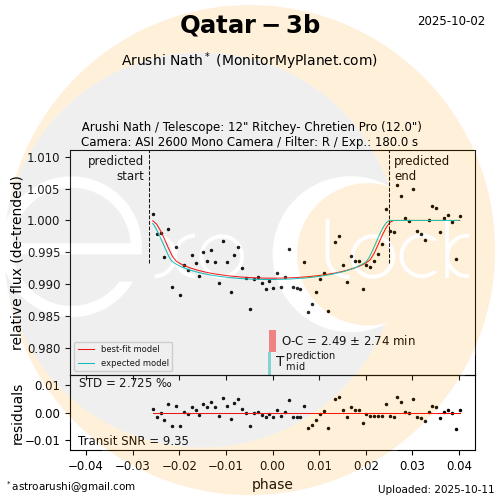
Qatar-4b · 2025-10-02 - Super-massive hot Jupiter (6.1 Jupiter masses) on a faint star; a deep 1.9% transit.

TOI-3819b · 2026-02-20 - TESS-discovered hot Jupiter.
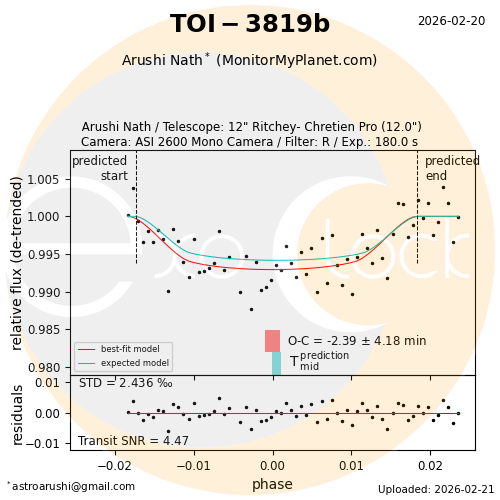
XO-6b · 2026-02-23 - A hugely inflated, massive hot Jupiter (2.1 Jupiter radii).

HAT-P-59b · 2026-06-24 - Hot Jupiter, 4.1-day orbit.

HAT-P-23b · 2026-06-25 - Compact hot Jupiter on a 1.2-day orbit.

Networks: ExoClock (ESA Ariel exoplanet ephemerides); IAU Minor Planet Center observatory code R60.